Josh Martin Marketing

Translate

Sunday, January 31, 2016

Maps Advertising is Here & Why You Shouldn’t Be Surprised

Source: SocialSEO
maps
Google has been slow to roll out its changes to Google Maps and AdWords. And this is with Google reason. Since Maps launched in 2005, they have struggled to make a monetizable maps listing. The concern was, if you give the advertisers too much control, the maps listings would become irrelevant to the searchers.
In 2008, Google took the first step to creating maps advertising with the launch of “Google My Business”. And again in 2011 with the re-branding of “Google My Business” as “Google Plus”. Google had successfully incentivized millions of business owners to sign up for a free listing with “Google My Business”. This information was then used to make relevant maps listings and social media profiles.
Now Google has the largest business directory in the world, but the question remained; how do they monetize this newly created audience without watering down the relevancy of the maps and directions search results? The answer is to take the advertising placement out of the hands of marketers and into the control of Google. By using a tried and true metric, quality score; Google has been able to make a grand compromise.
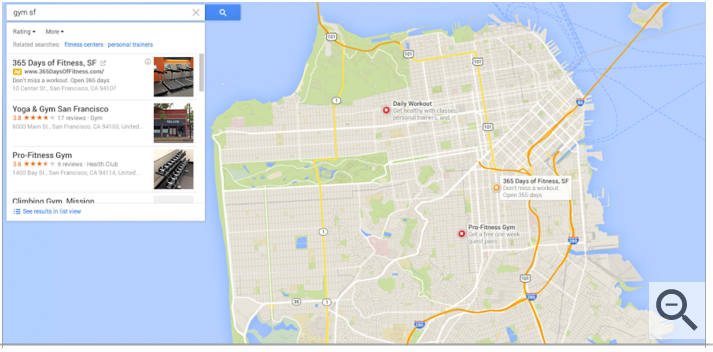
Advertisers can choose to participate in maps listings, but cannot choose when and where the advertisements display. Eliminating the possibility of off the charts directions or irrelevant search results. The Maps Advertisements will display, if the advertisements quality score is high and the location is relevant to the searcher's location.
Additionally, this is a great way for Google to improve paid search as a whole. As Pay Per Click managers rush to join the Map Advertising bandwagon, the less-than-quality advertisers will find their quality score to be a road block. Forcing them to reevaluate the campaign and to improve its relevancy.
For PPC Managers that feel this would be too much of a burden, consider this. If you begin maps advertising, you and your clients can now track “Free Clicks”. These clicks have technically always been free, but we now have the ability to collect data on how often people engage with maps features like:
  • Saved Locations
  • Shared Locations
  • Navigation Clicks
(some not free, but trackable clicks include; phone clicks, location detail clicks, and sitelink clicks)
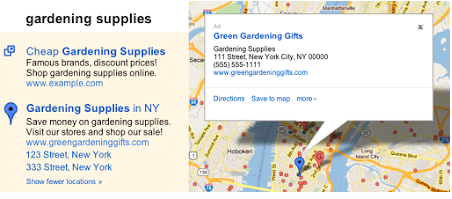
maps 2
With this change, a lot of people are concerned that their free listings will go away. Fortunately, that isn’t the case; with maps advertising you are paying for additional space and ad-content within your existing listing. This is not paying for higher (or irrelevant) placements within the maps search results.
If you are interested in learning more about how you can begin Maps advertising, please reach out to our pay per click team; here at SocialSEO.

Written By: Josh Martin
Source: SocialSEO

Wednesday, September 23, 2015

A Great & Free Online HTML Editor

I found a great online HTML editor called QuackIt. I practically never endorse anything; other than Google Adwords. In this case, I have not be incentivised or paid to do so.

This editor is ideal for tweaking tables, adding videos, and images to already existing sites with an established CSS and CMS. To operate the editor you need basic Microsoft Word Skills, but you can also edit the source HTML directly. Meaning you can copy and paste into and out of this editor with ease.

I have a client who needs to change a landing page on their site weekly, but can not afford a developer. With a brief training session, I was able to teach them to make the code and export it to their site. this saved time and money, but also keeps "too many cooks from getting into the kitchen".

Additionally QuackIt has many editors and a wealth of tutorials. Enjoy!


HTML Editor: 
http://www.quackit.com/html/online-html-editor/

Friday, May 29, 2015

Pre Roll Ads Are More Effective - Video Blog


A new study conducted by AOL shows that video pre roll ads are more effective on short form videos than on longer video content. The study, which was released as an infographic, shows that viewers are 42% more likely to make a purchase from a brand whose ad they viewed before watching short form video content. Brand recall and affinity also go up for video pre roll ads in front of short form content when compared to long form content. An article published at VentureBeat explains that, “The findings contradict the traditional logic that the standard 30-second TV commercial is the most effective in swaying an audience.”

The study also shows that “viewers are adopting traditional avoidance behaviors during ads within long-form videos.” Instead of viewing the ads on long form content, they’re using their phones, opening other websites or even walking away – in short, the same behaviors they’d use when watching television without DVR.
Here are a few more interesting points from the study:
  • Ads in short-form videos are more effective than ads in long-form content. More specifically, short-form video produced a 25 percent higher brand recall and a 42 percent higher purchase intent for the featured product or service.
  • Viewers are adopting traditional avoidance behaviors during ads within long-form videos. Respondents found the ads to be too frequent and interruptive; as a result, they chose to avoid them altogether (by walking away, going to other sites, multitasking with their phone). This is the same “annoyance” behavior that is demonstrated when viewing television without the use of a DVR.
  • Consumers want more targeted and humorous ads in both formats. In fact, 67 percent of respondents would be willing to be answer a question to make their ads more personalized and enjoyable.
  • Consumers understand the exchange of free content for advertising, but they want to make sure their time tradeoff of watching ads also benefits them. They found coupons, contests and links as the most positive forms of engagement.

Click here to view a great infographic or download the PDF

Thursday, May 28, 2015

Digital Video Ad Effectiveness Case Study 2008 - Time Flys?


Here is a little something I found today, what a trip down memory lane. Can you imagine a time where we questioned the usefulness of video pre-roll? Read on if you dare:


Despite the rapid growth of digital video advertising, marketers are still learning how to use the medium most effectively.  The IAB Research Council undertook a study of a video advertising campaign for a major national retailer brand. This research sought to provide insights into which combinations of lengths and placements of digital video advertising are most effective. The IAB commissioned Millward Brown and Dynamic Logic to undertake this research, which serves as a case study on digital video ad effectiveness. The findings of the study include the following:

15 seconds appears to be an optimal length for digital video creative in the pre-roll position. 5-second spots had trouble conveying a message; while 30-second spots risked turning off a viewer waiting to watch something else.

30-second spots do well at conveying a complex or emotionally resonant message, but work best in user-initiated placements (where the user must take an action, like clicking on an ad or rolling over an in-text link, to begin playing the ad) where viewers display more patience for long messages.
Pre-roll, in-text, and in-banner video ad placements can all contribute to achieving the goals of a campaign; however, different placements may perform optimally with different creative lengths.
As a single campaign case study, the findings here do not represent definitive conclusions. However, they do offer useful guidance for the industry, and point in productive directions for further research in the area of digital video creative length and placement.

Download the complete case study by clicking here

Monday, May 25, 2015

History Of Memorial Day - Video Blog


???????????????????

Memorial Day is a US federal holiday wherein the men and women who died while serving in the United States Armed Forces are remembered. The holiday, which is celebrated every year on the final Monday of May, was formerly known as Decoration Day and originated after the American Civil War to commemorate the Union and Confederate soldiers who died in the Civil War. By the 20th century, Memorial Day had been extended to honor all Americans who have died while in the military service. It typically marks the start of the summer vacation season, while Labor Day marks its end.
Many people visit cemeteries and memorials, particularly to honor those who have died in military service. Many volunteers place an American flag on each grave in national cemeteries.
Annual Decoration Days for particular cemeteries are held on a Sunday in late spring or early summer in some rural areas of the American South, notably in the mountains. In cases involving a family graveyard where remote ancestors as well as those who were deceased more recently are buried, this may take on the character of an extended family reunion to which some people travel hundreds of miles. People gather on the designated day and put flowers on graves and renew contacts with kinfolk and others. There often is a religious service and a "dinner on the ground," the traditional term for a potluck meal in which people used to spread the dishes out on sheets or tablecloths on the grass. It is believed that this practice began before the American Civil War and thus may reflect the real origin of the "memorial day" idea.
Memorial Day is not to be confused with Veterans Day; Memorial Day is a day of remembering the men and women who died while serving, while Veterans Day celebrates the service of all U.S. military veterans.

History of the holiday

flags-in-memorial-day-2004-photo-012The practice of decorating soldiers' graves with flowers is an ancient custom Soldiers' graves were decorated in the U.S. before and during the American Civil War. A claim was made in 1906 that the first Civil War soldier's grave ever decorated was in Warrenton, Virginia, on June 3, 1861, implying the first Memorial Day occurred there. Though not for Union soldiers, there is authentic documentation that women in Savannah, Georgia, decorated Confederate soldiers' graves in 1862. In 1863, the cemetery dedication at Gettysburg, Pennsylvania, was a ceremony of commemoration at the graves of dead soldiers. Local historians in Boalsburg, Pennsylvania, claim that ladies there decorated soldiers' graves on July 4, 1864. As a result, Boalsburg promotes itself as the birthplace of Memorial Day. Following President Abraham Lincoln's assassination in April 1865, there were a variety of events of commemoration. The sheer number of soldiers of both sides who died in the Civil War, more than 600,000, meant that burial and memorialization took on new cultural significance. Under the leadership of women during the war, an increasingly formal practice of decorating graves had taken shape. In 1865, the federal government began creating national military cemeteries for the Union war dead. The first widely publicized observance of a Memorial Day-type observance after the Civil War was in Charleston, South Carolina, on May 1, 1865. During the war, Union soldiers who were prisoners of war had been held at the Charleston Race Course; at least 257 Union prisoners died there and were hastily buried in unmarked graves. Together with teachers and missionaries, black residents of Charleston organized a May Day ceremony in 1865, which was covered by the New York Tribune and other national papers. The freedmen cleaned up and landscaped the burial ground, building an enclosure and an arch labeled, "Martyrs of the Race Course." Nearly ten thousand people, mostly freedmen, gathered on May 1 to commemorate the war dead. Involved were about 3,000 school children newly enrolled in freedmen's schools, mutual aid societies, Union troops, black ministers, and white northern missionaries. Most brought flowers to lay on the burial field. Today the site is used as Hampton Park. Years later, the celebration would come to be called the "First Decoration Day" in the North. David W. Blight described the day:
"This was the first Memorial Day. African Americans invented Memorial Day in Charleston, South Carolina. What you have there is black Americans recently freed from slavery announcing to the world with their flowers, their feet, and their songs what the war had been about. What they basically were creating was the Independence Day of a Second American Revolution.”
However, Blight stated he "has no evidence" that this event in Charleston inspired the establishment of Memorial Day across the country. On May 26, 1966, President Johnson signed a presidential proclamation naming Waterloo, New York, as the birthplace of Memorial Day. Earlier, the 89th Congress adopted House Concurrent Resolution 587, which officially recognized that the patriotic tradition of observing Memorial Day began one hundred years prior in Waterloo, New York. According to legend, in the summer of 1865 a local druggist Henry Welles, while talking to friends, suggested that it might be good to remember those soldiers who did not make it home from the Civil War. Not much came of it until he mentioned it to General John B. Murray, a Civil War hero, who gathered support from other surviving veterans. On May 5, 1866, they marched to the three local cemeteries and decorated the graves of fallen soldiers. It is believed that Murray, who knew General Logan, told Logan about the observance and that led to Logan issuing Logan's Order in 1868 calling for a national observance

Compiled By: Josh Martin

Wednesday, May 20, 2015

8 Sure Ways to Increase AdWords Click Through Rate (CTR)

There are times you just want to increase your click-through rates. You might need to raise it to help Quality Scores, increase traffic, or gain visibility for a new product.

Often by just raising click-through rates, you might not be raising your conversion rate. You can even decrease your conversion rates with ads. However, we’re going to focus on raising click-through rates regardless of how it affects other metrics.

As always, you should be testing this for yourself to see what helps your overall account’s goals.

Adding An Extension
One of the easiest ways to increase click-through rate that also helps conversion rate is to use ad extensions. Ad extensions will help you take up more real estate on the page and show additional information with your ads. You can add extensions for local, social, products, and there is even a beta contact and subscription extension.

If you have yet not added extensions, do so now.

Add Sitelinks
Sitelinks are a type of extension so this could be grouped with adding an extension except there is one big difference between all the other extensions and sitelinks.

With the other extensions, only one extension will show with an ad. You can have sitelinks show with another extension. This is another no-brainer to add. With sitelinks, you can add additional benefits or navigation into your site directly from the ad copy.

Extended Headlines
The absolute easiest way to increase click-through rates if your ads are shown above the organic results is to end your description line 1 with a punctuation mark. When you do so, the description line 1 is added to the headline and really makes the ads stand out.

Take a look at these three ads:


The first two ads have very long headlines. The third ad does not. All the third ad has to do to have a longer headline is to add a period after ‘Low Fare Guaranteed On All Flights’. That’s it. As soon as that change was made, the ad would have an extended headline.

Consider The Display URL As Marketing Copy
Your display URL does not have to be an actual URL. As long as your root domain in the ad and site are the same, you can consider the rest of the URL as marketing copy. The display URL can be 35 characters long – don’t waste the space.

You can add a product name, feature, benefit, or other aspects to the display URL to make the ad copy more attractive. To learn more about display URLs, please see the article: Everything You Need To Know About AdWords Display URLs.

Seasonal Headlines
There is always some holiday or event on the horizon. In just the United States, there are more than 40 holidays at the national level. When you starting adding regional events such as the Boston Marathon, DC Cherry Blossom Festival, state fairs, parades, and much more; the list of events becomes endless.

When you add or reference events in headlines, your ads look very timely and relevant and can often have positive impacts on click-through rates.

Use Trademarks
Many consumers are brand conscious. When someone searches for a brand, they want to see that brand in the ad copy. You do have to be careful of the legalities around trademarks; however, adding those well-recognized words to the ad can make a large difference to your CTRs.

Remove Price; Ad Discounts
A price in an ad copy reminds the searcher they need to spend money. Often removing the price can help CTRs. It is also useful when you’re not the cheapest ad on the page.

While we don’t like to always spend money, everyone likes a good deal. Instead of putting your price in the ad, switch your offer to a discount. Instead of spending $50, someone is going to save $10. What would you rather do, spend $50 or save $10?

In many countries, people do not get the concept “just because it’s on sale does not mean it’s free.” Discounts often outperform prices in ads.

Give Something Away for Free
Who doesn’t want something for free? Put something in your ad that’s free. A free consultation, free gift, buy one get one free, a free whitepaper. It doesn’t matter – it’s free.

Test For Yourself
While these 8 methods often work – they don’t always.

I recently saw an account where when the word ‘free’ appeared in an ad, their ads had a lower CTR than if they focused on experience or value. Removing all instances of free from the ad copies and switching the value proposition to experience raised both their CTRs and their conversion rates.

The next day, I was working on account in a very similar industry and when the word ‘free’ appeared in the ad, their ads had a much higher CTR and the same conversion rates as the other ad types.

If you need to raise your click-through rates, these ideas can help you gain a solid starting place. However, always test for yourself. Only you can truly know what happens to your account’s profits as you change your ads to bring more visitors to your site

Tuesday, March 31, 2015

History of April Fools Day - Video Blog

[youtube http://www.youtube.com/watch?v=OhVCTkpVX2Y?rel=0]
Video Produced By: Jeremiah Warren
20130401-113545.jpg20130401-113417.jpgApril Fools' Day is celebrated in many countries on April 1 every year. Sometimes referred to as All Fools' Day, April 1 is not a national holiday, but is widely recognized and celebrated as a day when people play practical jokes and hoaxes on each other. In Italy, France and Belgium, children and adults traditionally tack paper fishes on each other's back as a trick and shout "April fish!" in their local languages (pesce d'aprile!, poisson d'avril! and aprilvis! in Italian, French and Flemish, respectively). Such fish feature prominently on many French late 19th to early 20th century April Fools' Day postcards.The earliest recorded association between April 1 and foolishness is an ambiguous reference in Chaucer's Canterbury Tales (1392). Many writers suggest that the restoration of January 1 by Pope Gregory XIII as New Year's Day of the Gregorian Calendar in the 16th century was responsible for the creation of the holiday, sometimes questioned for earlier references. Origins Precursors of April Fools' Day include the Roman festival of Hilaria, held March 25, and the Medieval Feast of Fools, held December 28, still a day on which pranks are played in Spanish-speaking countries. In Chaucer's Canterbury Tales (1392), the "Nun's Priest's Tale" is set Syn March bigan thritty dayes and two. Modern scholars believe that there is a copying error in the extant manuscripts and that Chaucer actually wrote, Syn March was gon.[5] Thus, the passage originally meant 32 days after April, i.e. May 2, the anniversary of the engagement of King Richard II of England to Anne of Bohemia, which took place in 1381. Readers apparently misunderstood this line to mean "March 32", i.e. April 1. In Chaucer's tale, the vain cock Chauntecleer is tricked by a fox. In 1508, French poet Eloy d'Amerval referred to a poisson d’avril (April fool, literally "April fish"), a possible reference to the holiday. In 1539, Flemish poet Eduard de Dene wrote of a nobleman who sent his servants on foolish errands on April 1. In 1686, John Aubrey referred to the holiday as "Fooles holy day", the first British reference. On April 1, 1698, several people were tricked into going to the Tower of London to "see the Lions washed". In the Middle Ages, up until the late 18th century, New Year's Day was celebrated on March 25 (Feast of the Annunciation) in most European towns. In some areas of France, New Year's was a week-long holiday ending on April 1. Many writers suggest that April Fools originated because those who celebrated on January 1 made fun of those who celebrated on other dates. The use of January 1 as New Year's Day was common in France by the mid-16th century,[6] and this date was adopted officially in 1564 by the Edict of Roussillon. A study in the 1950s, by folklorists Iona and Peter Opie, found that in the UK and those countries whose traditions derived from there, the joking ceased at midday. But this practice appears to have lapsed in more recent years.

 Source: Wikipedia
Compiled By: Josh Martin

Monday, March 16, 2015

Digital Video Advertising is Set to Take A Bite Out of TV


Digital video advertising in the US is increasing at an eye-popping rate, but TV ad spending will still outpace digital video in dollar growth in 2014, according to new figures from eMarketer. Digital video ad spending will increase 41.9% this year, reaching $5.96 billion, while TV advertising in the US will grow 3.3% to hit $68.54 billion.


Due to the two media’s varied stages of maturity, growth rates between TV, a well-established market, and digital video—more recent on the scene, but becoming increasingly prominent—will trend in different directions. The uptick in usage on digital devices is an important contributor to growth in ad spending for these sectors, but by no means will carry enough momentum to overtake the TV market in the near future.
A more comparable statistic for the two markets is the amount of ad dollars each platform will add each year. Despite digital video’s astronomical rise percentagewise, eMarketer projects that TV will add more new dollars this year—$2.19 billion more than 2013, compared with a $1.76 billion increase in digital video ad spending. In addition, we estimate that TV will continue to outpace digital video in dollar growth through 2018. In 2016, for example, our projections show TV almost doubling the amount of new dollars going to digital video channels, due chiefly to advertising surrounding the upcoming US presidential election that year.
“The digital video audience is spread more thinly than a mass television audience, and that segmentation makes digital video ad buys more complex and less reliable than TV advertising,” said David Hallerman, principal analyst at eMarketer. “Time spent with digital video is growing significantly, and it’s taking away some TV time, but given the diversity of placements and platforms, digital video viewers are more difficult for advertisers to target.”
Furthermore, Hallerman added, “much of the time audiences spend with digital video is not useful for advertisers. Some of that is when they view clips that are either too short or not brand friendly. But it’s also because more and more digital video content is streamed through subscription services such as Netflix or Amazon Prime Video—neither of which supports advertising.”
Similar to the reasons that TV is still outpacing digital video ad spending, online video remains well ahead of ad investments in video programming on smartphones and tablets—for the time being. Overall, eMarketer estimates that online video ad spending—that is, ad spending primarily on desktop-based ads—will total $4.52 billion in 2014, or 75.8% of digital video ad spending, vs. $1.44 billion for video ad spending on tablets and smartphones. By 2018, those figures will draw more closely together, when online will still slightly outspend mobile video—$6.64 billion to $6.07 billion.
Video ad spending on connected TVs—devices such as set-top boxes, smart TVs and gaming consoles, for example—is accounted for in the “online” portion of video ad spending in eMarketer’s definition, which partially accounts for the growth there in contrast to our mobile category. As desktop advertising declines in favor of tablet and smartphone advertising, connected TVs will help pick up slack in the “online” category. According to eMarketer’s latest forecast, 113.2 million US consumers, or nearly 60% of digital video viewers, will use connected TVs in 2014. By 2018, that figure is projected to reach 90.0% of digital video viewers.
“As audiences find it easier and easier to watch internet-sourced content on their TVs, and as more and more content compels them to watch, the connected TV universe will offer marketers a unique blend of digital interactivity and TV’s big-screen power,” said Hallerman.
eMarketer bases all of its forecasts on a multipronged approach that focuses on both worldwide and local trends in the economy, technology and population, along with company-, product-, country- and demographic-specific trends, and trends in specific consumer behaviors. We analyze quantitative and qualitative data from a variety of research firms, government agencies, media outlets and company reports, weighting each piece of information based on methodology and soundness.
In addition, every element of each eMarketer forecast fits within the larger matrix of all of its forecasts, with the same assumptions and general framework used to project figures in a wide variety of areas. Regular re-evaluation of each forecast means those assumptions and framework are constantly updated to reflect new market developments and other trends.
Data Sources:
emarketer.com

Wednesday, December 31, 2014

8 Things Your Doing Wrong In Google Adwords

1.  Choosing the Wrong Keywords

Many advertisers think there's no harm in having countless keywords in their campaigns just to cover their bases, but this is false logic. First of all, having too many non-performing keywords in your campaign can actually bring your overall campaign down, which in turn can lead to increased expenses to generate the same results.

Second of all, if you focus on only choosing keywords that generate clicks but no conversions, you're helping Google make a tidy sum off of you without helping yourself.

Lastly, certain words with multiple meanings might also bring down your campaign performance if the ad is served a lot but not clicked or could lead to wasted expense. Take for example the word "windows." In the example below, an ad for Microsoft Windows (software) appears among all other ads for glass windows for a building. Perhaps this ad is appropriately located (and if you have the advertising budget of Microsoft, you probably don't care), but also considering that Microsoft Windows has the No. 1 free organic search ranking on Google, perhaps it's an unnecessary placement.


2. Writing Bad or Boring Ad Copy

You might be surprised at how artful writing only 95 characters of ad copy can be. Unlike the below example, make sure you give the searcher a compelling reason to click your ad.

Some AdWords copywriting tips include:
  • a headline with specific content, messaging or an offer
  • use of your keyword somewhere in the ad copy
  • a persuasive call to action like "Save now," "Buy our..." or "Register here"

3. Not Fully Understanding or Using All Campaign Set-up Options

Google makes basic campaign set-up easy, but they don't necessarily expose all the different ways you can configure and manipulate your campaign to help improve results. Educate yourself on the use of these features to get more results for the same or less money:
  • AdGroups--the grouping of like or objective-related keywords into a group so you can impose campaign controls at the Group level
  • Ad targeting--there are so many fabulous ways to target better through AdWords--by keyword (of course), by geography, by time of day ("day-parting"), by content, by mobile users--take time to become familiar with all of the targeting methods so you can optimize your campaign and maximize your budget
  • Match types--match types tell Google under what conditions of a search query to serve your ad. There are five main types of match types: Broad, Broad Modifier, Phrase, Exact, and Negative. Get familiar with how each type works to improve your campaign.
  • Keyword insertion--with keyword insertion, Google inserts your select keyword into your ad text on-the-fly to try to make it more relevant for the user. You typically see this with big box retailer ads, for example:
  • Ad Extensions--Don't be limited by 95 characters any longer! With Ad Extensions you can get more links and expose more about your advertised product or service to your prospective buyer.

4. Not Implementing Conversion Tracking

 Without conversion tracking, you probably don't have a clear sense of which keywords are generating desired actions for campaign success. Google provides conversion tracking code for free. 

5. Not Tying Your Conversion Tracking Into Your Google Analytics

 Speaking of free, Google Analytics is one of the most powerful marketing tools out there, and it too is free. As a bonus, if you connect your AdWords conversion tracking to your Google Analytics, you can see all kinds of data your campaign is generating.

6. Unnecessarily Over-paying for Positioning

Most Google advertisers understand that AdWords is a live, 24/7 auction by keyword--the cost of your click is influenced by what all advertisers bidding on it are willing to pay. When you have a well-optimized campaign, chances are you don't have to pay top dollar to capture the first ad position...and nor does the number one position always suit you, the advertiser, best. You need to understand how the entire AdWords marketplace works, including Google's Quality Score, and how to best manage your campaign by keyword or goal.

7. Sending All the Traffic to Your Website's Homepage

Most campaigns benefit from driving traffic to unique "landing pages" where the searcher can more easily connect with the information they seek, rather than dumping them onto the homepage of your website and hoping they find what they came to your site for.

8. Not Conducting A/B Split Tests

Split testing allows you to serve two different versions of ad copy for the same keyword, or to take visitors to two different landing pages, all so you can test if one version of ad copy or landing page clearly outperforms another.

If you're managing your AdWords campaign yourself, it will be easier for you to tackle these fixes one at a time than all at once. Along the way, see how they improve your campaign performance...but don't forget to capture baseline performance metrics so you have something to judge against!

Thursday, December 25, 2014

History of Wrapping Paper - How to Wrap Video


Video Produced By: Real Simple How To

History of Wrapping Paper:
Before gifts were thought of being wrapped and put under a tree for children, kids would get a stocking (sock) of theirs, (the biggest they had) and find it filled on Christmas morning with fruit, candy, and perhaps a small toy.
temp4In the early Victorian years gifts were wrapped in white tissue paper. Bows were made from snippets of ribbon and lace that could be found lying around the house. Sometimes paper pictures from a greeting card were added as extra decorations for wrapping. Even a piece of outside greenery was added to the gift box. By 1903 gift wrapping was quite popular and in fashion, so the first printed wrapping paper was made which had green holly printed on it. Printed Christmas wrapping paper was actually developed by accident. Stores were selling white, red, and green tissue paper and selling out very quickly. The Hall brothers began to print their own and soon sales were as high as their greeting card business, hence, Hallmark card company. By the 1920's DuPont was making cellophane for decorative gift wrap and packaging material for food. Today gifts under your Christmas tree can be found wrapped in many different ways, styles, and kinds of paper. Papers and bows of all kinds of material are used, and toppings for the gifts can be anything like; another gift, Christmas tree ornaments, bows, flowers, candy, or greenery. Today neatly wrapped Christmas gifts can be seen in all corners of a room, some under the tree, on a sofa, on a mantel, stacked up high, or in a neat and decorative pile on the floor.

Perhaps You would Enjoy: The History of The Christmas Tree
Source: Love To Sew
Compiled By: Josh Martin


Wednesday, December 24, 2014

K900 Ushers In An Era Of Luxury And Affordability


The 2015 Kia K900 sedan gives you much of the spaciousness, luxury and technology of the Mercedes-Benz S-Class. Kia does it for $66,000, fully equipped, when the S-Class starts at $95,000. Kia provides the industry’s slickest and most useful blind spot detection by placing additional indicators in the head-up display. You can get ventilated, reclining rear seats. This is a car to watch.

Not all of the $15K-30K difference in price between the K900 and a full-size Audi, BMW or Mercedes is the markup possible — “gouging” is such a blunt term — from building a high-status car. Germany’s big three build cars that handle as well at the extreme. They've been building cockpit controllers for a decade and still have no handle on what works. The K900 cockpit fit and finish goes the extra distance.

 The K900 is the sister ship to Hyundai’s Equus, the K900 is a rear-drive, 420-hp V-8–powered luxury barge that indicates its maker’s ambitions. Expanding on established Kia styling themes, it’s a muscular four-door stuffed with leather, wood trim, and electronic amusements. The steering is responsive and the suspension is on point. The K900 is a value compared with its more-expensive competitors in full-size luxury, we’d rather spend less for a car that is better...

 Compiled By:
Josh Martin

 Sources:
extremetech.com 
caranddrive.com

Tuesday, December 23, 2014

Social Media Contest - Tips And Tricks

Social media contests can be very successful for your business if your goal is to increase your fan base, increase engagement or increase your email subscribers. Since email conversions are much higher than social media conversions, smart marketers like to create contests that capture people’s email addresses. This way, they can follow up with them later on and inform them about news and specials.
I had the opportunity to work with Out And About Marketing and help them execute their #SochiDailyGiveaway contest. Winning a pair of skis or snowboards during the Olympics sounds like a great hook for passionate skiers and boarders – exactly the audience Squaw Valley wants to attract.
It’s no secret snow has not been great in Lake Tahoe this year. Despite the lack of snow, interest and participation in the contest has been through the roof. After all, this ski resort did everything right with the social media contest. The incentive, the prize, the urgency, the timing and the viral sharing were all put into place with the contest. The social media vendor used for the contest was Heyo, a very affordable yet solid solution and one that I consistently recommend to my partners.
Squaw valley social media contest
The results of the contest so far have been outstanding:
In summary, here are 7 tips to make a social media contest successful:

- 6,975 new likes
- 30% email conversion rate


1. Make it relevant to your audience
2. Timing is everything
3. Keep it simple for people to enter
4. Make sure it’s mobile optimized
5. Come up with incentives guaranteed to get people to act
6. Capture their email addresses
7. Make it shareable to increase reach

Market Note: Social media is playing a major role in accelerating the decision cycle of consumers who patronize ski resorts. As a result, one of the country's largest such companies -- Vail Resorts -- has abandoned its long-time advertising strategies and practices. In their place, the billion-dollar-a-year corporation, which operates five major resorts and twenty hotels, has built a new in-house marketing operation that uses social media and other digital venues to constantly engage skiing enthusiasts in real time. CEO Rob Katz explains the dramatic changes.

Wednesday, December 17, 2014

Simple Tips To Set The Stage For Local SEO In 2015

After Google's most recent local algorithm update, the rules have changed for local SEO. Columnist Greg Gifford discusses how you can do well in local search in 2015.

The year is almost over, and many businesses are starting to look forward to 2015 and discuss their marketing plans. Luckily, David Mihm, the local search guru at Moz, just released his annual Local Search Ranking Factors survey, which helps give us local marketers more insight into which ranking factors matter the most.
The survey shows a definite shift toward more traditional web ranking factors. Last year’s Local Search Ranking Factors survey had Google Places and Citations weighted heavily, but this year’s study shows that on-site signals and links are the most powerful factors.
This shift is consistent with Google’s recent local ranking algorithm update, Pigeon. Many Local SEOs claimed they weren’t hit by Pigeon – but it’s more likely that, because they took a more wholesome approach to local SEO, their sites simply had more authority to begin with.
The most important point we try to hammer home to potential clients is that you can’t fool the nerds at Google. Everything you do, both on and off your site, should be working toward the end goal of making your user experience awesome… not trying to fool Google into placing you higher on search results pages.

So, taking what we’ve been able to figure out about the Pigeon update and adding in the results from the 2014 Local Search Ranking Factors survey, here are two simple tips to help you set the stage for Local Search success in 2015:
  1. Be Awesome
  2. Earn Awesome Links
Yes, it’s really that simple… but at the same time, it’s really not that easy for local businesses. Take a look at your competitors in your vertical – nearly every website has the same or similar content, and most sites don’t have that many inbound links.

Okay, So How Are You Supposed To Be Awesome?

The best thing you can do for Local Search success in 2015 is to take all the energy you put into trying to fool Google and instead use that energy to make your site better.
Take a long, hard look at your site and look at your competitors’ sites. What can you do to be better? You know that your potential customers will be looking at multiple sites, so make your site the best in your vertical.
Make sure you’re avoiding these common pitfalls – they’re all basic, but we still see far too many sites tripping up on these:
  1. No Home Page Content. Your customers (and search engines) need to know what you’re all about. If your home page has a slider/banner and just a few sentences, you need to add more useful content there immediately.
  2. Only A Few Sentences On A Page. Your customers (and search engines) are checking your website for useful, relevant information. If you offer a product or service, don’t just say, “We sell X, call us for more information!” Today’s shoppers want immediate information, so you need to pack every page with useful content.
  3. Spamming Keywords. Far too many websites rely on this outdated tactic. You’re not going to rank well everywhere in your state simply because you listed out 100 cities separated by commas on your home page. Does that huge list of cities provide useful information for customers? No. Does it help you rank in Google? Definitely not. Get rid of the junk and populate your site with relevant, informative content instead.
  4. Awful Title Tags. You’ve got about 500 pixels of width for your title tags; anything longer will be truncated when it’s displayed in search results. The title tag should summarize the page – it shouldn’t be a huge chunk of keywords you’re trying to rank for. Put your primary keyword phrase at the beginning and your business name at the end. If you’ve got 100 keywords stuffed into your title tag, you just look desperate.

Don’t Forget Your Local Optimization

With on-site signals now carrying so much weight, it’s more important than ever to have your local optimization ducks in a row. It won’t do you any good to bang out a ton of citations if your site doesn’t include the local signals that Google expects it to have.
Again, these are old-school basics, but we hardly see any websites correctly optimizing for local areas:
  1. Include City/ST in your title tag. Remember, the title tag is incredibly important for optimization, and including your city and state is an important signal for local relevancy.
  2. Include City/ST in your H1 heading. It doesn’t have to be the entire heading in and of itself — what’s important here is to include your city and state in the page heading to further show local relevancy.
  3. Include City/ST in your content. Far too many sites forget to include City/ST information inside the site content. Optimizing for local search won’t work unless you’re talking about your local area in your content.
  4. Include City/ST in your alt text on images. It’s amazing how many times we see sites that don’t include alt text. Remember, Google can’t see what’s in your images, so alt text helps provide a better understanding of your page content. Including City/ST information can really help boost local relevancy.
  5. Include City/ST in your URL. If you’ve got the ability to edit your URL structure, try to include your city and state information in your URLs. Again, this can go a long way toward providing a stronger local signal to both customers and Google. Important Note: if you’re going to update your URLs, don’t forget to set up 301 redirects so that the old address is permanently pointed to the new one.
These are all just specific tactics to help with the main goal: to make your site more awesome. Stop thinking about how to make your site rank, and start thinking about how to make your site the best in your niche. That’s how you’re going to get your site to rank better and convert more visitors.

soucre:
SearchEngineLand.com

Wednesday, December 10, 2014

How Search Engines Work - Video Blog


Search engines have two major functions - crawling & building an index, and providing answers by calculating relevancy & serving results.
Crawling and Indexing

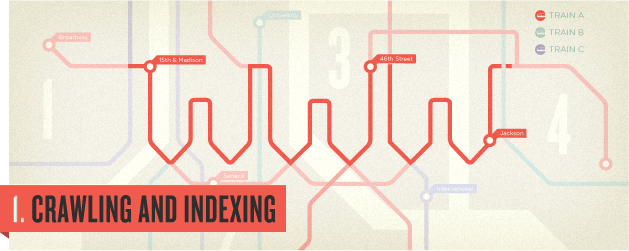
Imagine the World Wide Web as a network of stops in a big city subway system.

Each stop is its own unique document (usually a web page, but sometimes a PDF, JPG or other file). The search engines need a way to “crawl” the entire city and find all the stops along the way, so they use the best path available – links.
  1. Crawling and IndexingCrawling and indexing the billions of documents, pages, files, news, videos and media on the world wide web.
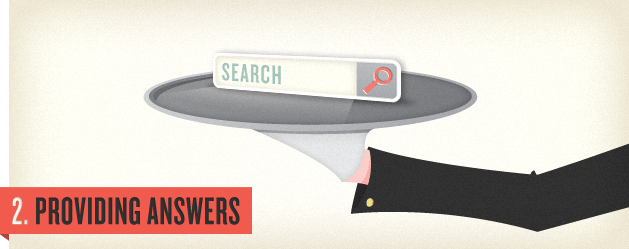
  2. Providing Answers Providing answers to user queries, most frequently through lists of relevant pages, through retrieval and rankings.
Large Hard Drive

“The link structure of the web serves to bind all of the pages together.”

Through links, search engines’ automated robots, called “crawlers,” or “spiders” can reach the many billions of interconnected documents.
Once the engines find these pages, they next decipher the code from them and store selected pieces in massive hard drives, to be recalled later when needed for a search query. To accomplish the monumental task of holding billions of pages that can be accessed in a fraction of a second, the search engines have constructed datacenters all over the world.
These monstrous storage facilities hold thousands of machines processing large quantities of information. After all, when a person performs a search at any of the major engines, they demand results instantaneously – even a 1 or 2 second delay can cause dissatisfaction, so the engines work hard to provide answers as fast as possible.
Providing Answers
Search engines are answer machines. When a person looks for something online, it requires the search engines to scour their corpus of billions of documents and do two things – first, return only those results that are relevant or useful to the searcher’s query, and second, rank those results in order of perceived usefulness. It is both “relevance” and “importance” that the process of SEO is meant to influence.

To a search engine, relevance means more than simply finding a page with the right words. In the early days of the web, search engines didn’t go much further than this simplistic step, and their results suffered as a consequence. Thus, through evolution, smart engineers at the engines devised better ways to find valuable results that searchers would appreciate and enjoy. Today, 100s of factors influence relevance, many of which we’ll discuss throughout this guide.

How Do Search Engines Determine Importance?

Currently, the major engines typically interpret importance as popularity – the more popular a site, page or document, the more valuable the information contained therein must be. This assumption has proven fairly successful in practice, as the engines have continued to increase users’ satisfaction by using metrics that interpret popularity.
Popularity and relevance aren’t determined manually. Instead, the engines craft careful, mathematical equations – algorithms – to sort the wheat from the chaff and to then rank the wheat in order of tastiness (or however it is that farmers determine wheat’s value).
These algorithms are often comprised of hundreds of components. In the search marketing field, we often refer to them as “ranking factors” Moz crafted a resource specifically on this subject – Search Engine Ranking Factors.

Source: Moz.com


Monday, December 8, 2014

Spooked - A Scarry Story Collection From Snaped Judgement


See No Evil:
The trouble began in Sri Lanka, when Chandra’s aunt woke up one day and couldn’t move her arms or legs.  The doctors had no answers, but a mysterious priest led the family on a quest to find the truth beyond medical science.

Listen To The Story Now 


Haunted Hacienda:
Rita found a gorgeous place to stay for dirt cheap.  Problem was, she didn’t much care for her roommate.

Listen To The Story Now

Produced by Rita Daniels.


Chinese Seer:
Lee kept seeing things, hearing voices and noises late into the night.  As Lee’s mind slowly lost its grip on reality, a Chinese mystic (thousands of miles away) lent a helping hand.

Produced by Stephanie Foo.


Judge Not:
The good Judge has always gotten his way.  But he’s dead.  And there’s a new sheriff in town.


My Special Friend:
Baywatch’s Donna D’Errico tells a story about her childhood best friend, Nancy.  At first, she seems like the best playmate a girl could ask for, but then things go terribly wrong.

Listen To The Story Now 

Thanks to Celebrity Ghost Stories and the Bio channel for this story. 


Pastors Oil:
Glynn’s friend Jenny is sick.  Up in her room, she’s shaking like there’s something inside of her. And Glynn is about to find out what . . .

Listen To The Story Now 

Story by Glynn Washington. Produced by Stephanie Foo.


Annabelle:
When one woman decides to rebuild an old home, she finds that it is currently occupied.


Graveyard Shift:
An apprentice mortician spends his first night alone with a body and finds out how the dead can possess the living. A true story by the writer and performer Kyle Bowen. Kyle Bowen is a real life graduate of the San Francisco college of Mortuary Science, and has worked as a mortician for over 15 years. He now writes and performs in Chico, CA.

Listen To The Story Now


One Man's Bargain:
When Ken's crazy neighbors go into foreclosure, he starts eyeing their 10-acre farmstead. Everyone tells him it's cursed, but of course, Ken doesn't believe in those silly things. Until mysterious events start engulfing his family . . . Thanks so much to Emile Klein for venturing into the haunted house to get this story. 

Listen To The Story Now 

Check out his storytelling and art project, You're U.S.

Producer: Stephanie Foo and Emile Klein


The Dud:
When Cisco was a young boy, the kids in his hood played a very dangerous game.


Old Pictures:
Nicole Selken found the perfect room in a Victorian house to rent. When she first walked in, the house was empty except for some old photos of past owners. She didn't know how well she'd get to know them. Niki now lives in San Francisco. Check out her website!


Producer: Stephanie Foo

Mo' Poltergeists, Mo' Problems:
It's not easy to scare a fifth degree black belt and professional martial arts instructor. But it can be done...


Someone to watch over me:
Glynn's friend Matt discovers a new talent one day while selling frozen submarine sandwiches-- a connection to the spiritual world. But the talent soon becomes a curse when his girlfriend falls ill.
Producer: Stephanie Foo


The Raven:

Download Clip
Once upon a midgnight dreary, as he ponders weak weary - Glynn loses his damn mind...

Listen To The Story Now
Susan's dog Daikon kept giving signs that an intruder was haunting her old
Victorian in New Orleans.  Then one night in October, the intruder crossed


Exorcist:
Download Clip
Alan worked at a mental hospital in the midwest. He asked to be transferred to
the acute ward, which housed some of the most psychotic people in the area. request was approved...

Producer: Nick van der Kolk.

Prince of Darkness:
Download Clip
Snap gets a visit from the most tortured storyteller of all time,
The Prince of Darkness.

Listen To The Story Now
Producer:  Pat Mesiti-Miller


Into the Catacombs:

Download Clip
While working with cocoa farms in South America, a chocolatier takes a trip to Peru and tours the catacombs of the Iglesia de San Francisco. Surrounded by bones, Brad takes a haunting picture that stays with him in the worst way.

Listen To The Story Now

Producer: Pat Mesiti-Miller


Mary, Mary, and Mercy:

Download Clip

Nate DiMeo, creator of the wonderful history podcast, 'The Memory Palace' (listen, you will love it), drops a haunting story of people with good intentions...but horrific execution. 
Snap storyteller Jeff Greenwald dives into water that holds far more than just secrets. 

Listen To The Story Now

Producer:
Anna Sussman


Who you gonna call?:
Download Clip
 see

Snap producer Stephanie Foo has always been petrified of ghosts. So we
sent her to one of the most haunted locations in San Francisco--the
abandoned tunnels underneath the Warfield Theater.

Watch the film and see some of the creepy rooms of the
Warfield right here.


Beyond The Veil:

Glynn and his brother are woken from their slumber by an oddly familiar face.


Listen To The Story Now
Producer: Pat Mesiti-Miller


The Invisible Children:

Download Clip
What happens when you spend your life savings on a dream house, and
find out someone else's family already lives there.  Explore the full story in
Kathleen Mcconnell's book, Don't Call Them Ghosts.

Producer: Anna Sussman. Sound design by Renzo Gorrio.


The Seance:

Download Clip
When friends get together for a little childhood fun, things get real. Fast.
To hear the original full length version that first appeared on KCRW's
UnFictional, check out their webpage.

Producer: Bob Carlson


The Djinn Inside:

Download Clip
An Islamic summer camp in Northern Michigan is turned upside down when
a young man becomes possessed by Djinn.

Producer: Anthony Briones

Sound Design: Stephanie Foo

Speaking Ill of the dead:
What happens when your three-year old's toys actually spring to life.

Listen To The Story Now

Read all about Gary Jansen's story in his book Holy Ghosts.


Granny told him to keep the voices "secret." But the voices told him something else.

Producer: Pat Mesiti-Miller


The Watery Grave:

Download Clip
Snap's own Eliza Smith was in bed one night when she felt someone in the
room. He was cold, he was wet, and he was scared. And Eliza knew exactly
who he was. 

Producer: Julia DeWitt with Eliza Smith


The Polaroid Phantom:

Download Clip
For the first time ever on Snap Judgment, it?s a ghost story with photographic
evidence. Two men living outside of Los Angeles encounter a ghost so
undeniable, they have to fight back to press and the rest of the world to
maintain their sanity.

Listen To The Story Now

See the pics for yourself:  Here

Also see pics here: http://www.seeingthingsthebook.com/video2.html

Producer: Anna Sussman
Sound design: Pat Mesiti-Mille

The Inpatients:
Download Clip
Kirsten decides to visit an abandoned mental hospital, where her cousin was kept. She discovers something still there.
Find out more about Kirsten's story on her website.

Listen To The Story Now


Fresh Laundry:

Download Clip
David Domine bought a run down old house in what is known as ?The Most Haunted Neighborhood In America." What he found during the renovations made him question EVERYTHING.

Find out more about David?s house and Old Louisville in his book, "True Ghost Stories and Eerie Legends from America's Most Haunted Neighborhood" or www.daviddomine.com

Producer: Anna Sussman

The Unicorn Princess:
This story comes to you from our Kickstarter Spooked V Listener Stories Contest winner Maria Serratore-Gunter.

Maria always got double the presents on Christmas because her birthday was the next day. But there was one present she always looked forward to most: her aunt's present. Every year, Maria's aunt bought her a doll for her doll collection. So when the day rolled around Maria was a senior in high school she opened her aunt's present first. Low and behold it was another doll. But this doll was unlike any Maria had ever seen. And she would never want to see it again.

Producer: Julia DeWitt


Popular Posts